Mansoura University Publishes an Important Scientific Study in the International Journal Science
Minister of Higher Education Congratulates Mansoura University on This Outstanding Scientific Achievement
Discovery of a New Ape Ancestor Redraws the Evolutionary Map of Great Apes
“Masripithecus”... An Egyptian Discovery That Places North Africa at the Heart of Great Ape Evolution
Dr. Abdelaziz Qansoua affirms:
- A global achievement that strengthens Egypt’s soft power through scientific research
- Investment in scientific research supports Egypt’s regional and international standing
- Egypt proves its ability to produce impactful knowledge shaping global research trends
- Publishing in Science confirms the success of national strategies and enhances the leadership of Egyptian universities
President of Mansoura University:
- Publishing in Science represents the pinnacle of excellence and reflects the strength of scientific research and efforts to enhance international publication at the university
- Egyptian researchers are capable of competing globally thanks to a supportive scientific environment
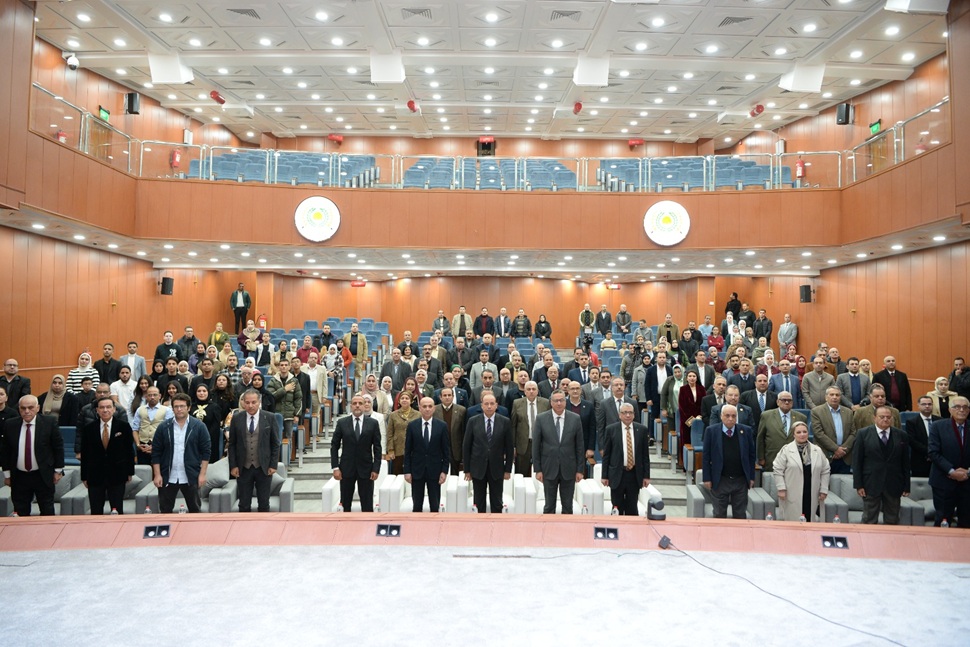
Dr. Abdelaziz Qansoua, Minister of Higher Education and Scientific Research, and Dr. Sherif Khater, President of Mansoura University, witnessed an event organized by the university to announce a significant Egyptian scientific achievement. This follows the success of the university’s Vertebrate Paleontology Center “Salam Lab,” led by Dr. Hesham Sallam, in publishing a study in the prestigious international journal Science—a research work fully conducted and published from within an Egyptian institution.
The Minister congratulated the university on this distinguished scientific achievement, emphasizing that it reflects the capability of academic institutions to contribute to global knowledge production. He noted that the state, under the leadership of President Abdel Fattah El-Sisi, places great importance on developing higher education and scientific research through policies that support research excellence, enhance international publishing, and foster scientific partnerships, alongside investing in human capital and infrastructure. In this context, efforts are being made to provide a stimulating scientific environment that enables Egyptian researchers to innovate and compete on major global scientific platforms, thereby strengthening Egypt’s regional and international standing and consolidating its role as a soft power rooted in science and knowledge.
Dr. Qansoua also affirmed that publishing this research in Science, one of the world’s most prestigious scientific journals, demonstrates that the state’s strategic directions are beginning to bear fruit. It also proves the ability of Egyptian universities to produce high-level scientific knowledge that contributes to advancing human understanding in advanced fields. He added that the significance of this achievement extends beyond being a scientific milestone for an Egyptian institution to the scientific value of the discovery itself, which reinforces the importance of North Africa and the Middle East as key regions in understanding the evolution of life on Earth, rather than merely geographic corridors.
The Minister praised the prominent role of Mansoura University under the leadership of Dr. Sherif Khater, highlighting its status as a leading research university that supports scientific excellence and links its outputs to societal issues. He commended the efforts of the Vertebrate Paleontology Center and the “Salam Lab” team led by Dr. Hesham Sallam in building a specialized national scientific school that culminated in this global achievement after years of research. He also praised Dr. Shorouk El-Ashqar for leading and publishing the study in Science, reflecting the growing role of Egyptian women in scientific research. Additionally, he expressed appreciation for the institutional support provided by the university and the Science, Technology and Innovation Funding Authority (STDF) in creating a conducive environment for this achievement.
In conclusion, Dr. Konsowa emphasized that this achievement marks the beginning of a new phase aimed at multiplying successes, strengthening Egypt’s position as a regional and international hub for knowledge production, and supporting researchers in addressing major scientific challenges. He extended his congratulations to Mansoura University, Dr. Hesham Sallam and his team, and all contributors to this accomplishment, expressing confidence in the ability of Egyptian scientists to continue excelling, making science the shortest path toward a better future for Egypt.
For his part, Dr. Sherif Khater congratulated the team on this global achievement, noting that publishing in Science represents the highest level of international scientific excellence and reflects the strength of the university’s research system and its ability to produce knowledge that competes at the highest global levels.
He explained that this success, achieved under the guidance of the political leadership and within the framework of Egypt Vision 2030, which supports scientific research and innovation, embodies the result of serious scientific effort originating from Mansoura University and contributes to strengthening its position on the global research map. He affirmed the ability of Egyptian researchers to compete internationally.
Dr. Khater added that this success reflects Egypt’s possession of distinguished scientific minds and that providing a supportive and stimulating research environment is fundamental to achieving such accomplishments. He stressed that the university’s role extends beyond education to producing globally impactful scientific knowledge.
He further noted that the university takes pride in this team, which has not only elevated its name but also honored Egypt as a whole, presenting a distinguished model of serious scientific research. He emphasized that this achievement aligns with the university’s strategy focused on supporting scientific research, encouraging innovation, and preparing cadres capable of international competition. He praised the efforts of the postgraduate studies and research sector, noting that this achievement crowns the university’s policies in developing the research system and enhancing international publication in prestigious journals.
Dr. Tarek Ghaloush, Vice President for Graduate Studies and Research, affirmed that the university continues to support its researchers and empower them to reach the highest levels of scientific excellence, believing in the role of research in enhancing Egypt’s regional and international standing and consolidating its soft power.
He added that publishing in Science is a direct result of institutional policies that support research excellence, promote international publication in high-impact journals, build researchers’ capacities, and provide a stimulating research environment based on interdisciplinary integration and openness to international partnerships.
The research team ensured that the name reflects Egyptian identity, as “Masripithecus” combines “Masr” (Egypt) with the Greek word “pithecus” meaning “ape,” while “moghraensis” refers to Wadi El-Moghra, the discovery site.
Dr. Shorouk El-Ashqar, the study’s lead author, explained that the fossil—although limited to parts of the jaw and teeth—carries significant scientific implications. It reveals a flexible diet based on fruit consumption with the ability to process harder foods, reflecting an early capacity to adapt to changing environments—one of the key traits behind the success and later spread of great apes.
She added that the study relied on an integrated evolutionary analysis combining molecular data from modern species with anatomical characteristics of fossils. It included around 60,000 genetic base pairs from 67 nuclear genes and 10 mitochondrial genes, along with 268 anatomical traits of modern and extinct apes, enabling the construction of a precise evolutionary tree and accurate placement of the new species.
In this context, Dr. Hesham Sallam stated that the team spent more than five years conducting field research in the Moghra region in search of great ape fossils, emphasizing that this discovery crowns years of dedicated work. He described the achievement as a strong message to Egyptian youth that competing at the highest global scientific levels is possible from within Egypt, and that investment in scientific research can place Egyptian institutions at the forefront of discoveries that reshape the history of life on Earth.
Professor Eric Seiffert, a paleontologist at the University of Southern California and co-author of the study, noted that the findings strongly challenge traditional theories that confined the origin of great apes to East Africa, expanding the geographical scope to include North Africa and the Middle East as key regions in this evolution.
It is worth noting that this research was supported and funded jointly by Mansoura University, the Science, Technology and Innovation Funding Authority (STDF) under the Ministry of Higher Education, and The Leakey Foundation, within the framework of supporting scientific research and strengthening international partnerships.
The research was published in Science under full Egyptian leadership from within Mansoura University, with an Egyptian lead researcher and full Egyptian funding. This reflects the transition of Egyptian research institutions from participation to leadership and their ability to produce globally competitive knowledge. The achievement is considered a major milestone in Egyptian scientific research, given the prestigious status and highly competitive standards of Science, which accepts only about 6% of submitted papers annually. It represents a qualitative leap in understanding great ape evolution, enhances the global standing of the Vertebrate Paleontology Center, and supports women’s empowerment, as Dr. Shorouk El-Ashqar became the first Egyptian female researcher to lead a study published in Science.
The research introduces a new species of great ape ancestors named Masripithecus moghraensis, which lived approximately 18 million years ago during the early Miocene epoch. Its fossils were discovered in Egypt’s Western Desert, representing the first confirmed evidence of great ape ancestors in North Africa, proving that the region was a primary habitat for their evolution rather than merely a geographic passage.