Here is a professional English translation suitable for publication on the Ministry’s website:
Prof. Dr. Abdelaziz Konsowa: We aim to provide AI tools within universities and build an integrated system that supports innovation and digital transformation
Eng. Raafat Hendy: We are committed to implementing digital transformation across all Egyptian universities and designing technology-based academic programs aligned with international standards to meet real labor market needs
In a strategic step toward
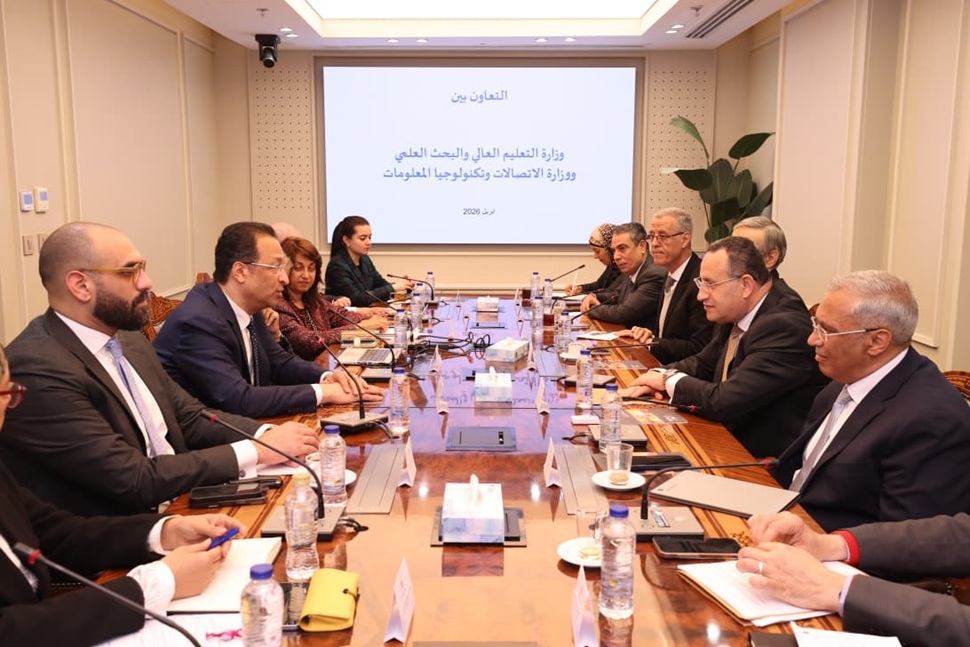
The meeting reviewed key areas of joint and proposed cooperation to develop the educational and research system using modern technologies, through four main pillars: capacity building, artificial intelligence, digital transformation, and support for innovation and entrepreneurship.
This meeting comes within the framework of the state’s commitment to investing in human capabilities and enhancing integration between the higher education and ICT sectors, contributing to preparing qualified cadres capable of keeping pace with rapid technological developments and enhancing the competitiveness of the Egyptian workforce regionally and internationally.
Prof. Dr. Abdelaziz Konsowa affirmed that the Ministry adopts a clear approach to promoting the use of artificial intelligence applications and tools within universities, supporting the development of education and scientific research. He explained that the coming phase will witness expanded use of modern technologies to enhance innovation and improve the quality of education, with a focus on training teaching assistants and assistant lecturers to build academic cadres capable of efficiently utilizing technology, thereby improving educational outcomes.
He also stressed the Ministry’s commitment to strengthening cooperation with the Ministry of Communications and Information Technology to implement strategic projects supporting digital transformation. He highlighted the importance of linking academic promotion to excellence in applied scientific research to align research with development needs and maximize its impact. He further emphasized the need to activate the knowledge economy by increasing the engagement of faculty members with industry, facilitating knowledge transfer and the practical application of research outcomes, and fostering a real shift in academic culture.
The Minister also outlined plans to establish Technology Parks within universities to support innovation and link scientific research with industry, emphasizing the importance of transforming research outputs into practical applications in line with international models. He noted that the Ministry is working to create a supportive environment for researchers through funding and innovation incentives, while preparing to launch joint initiatives with the Ministry of Communications to support applied projects through competitive mechanisms.
He further highlighted the pivotal role of the Science, Technology and Innovation Funding Authority (STDF) in supporting competitive projects and transforming research into practical applications that serve society and the knowledge economy. He emphasized that supporting students and graduates is a priority through providing advanced technological training to create real employment opportunities.
Additionally, the Minister noted efforts to establish integrated databases, particularly in artificial intelligence, to support decision-making, alongside attracting Egyptian scientists abroad to establish digital centers of excellence. He announced the launch of competitive funding for graduation projects starting from the next academic year, in addition to organizing technology and innovation competitions at local, regional, and international levels to enhance students’ skills and competitiveness.
For his part, Eng. Raafat Hendy affirmed the Ministry of Communications and Information Technology’s commitment to strengthening cooperation with the Ministry of Higher Education in building and expanding the human skills base in areas such as artificial intelligence, quantum computing, and emerging technologies. This supports the competitiveness of the ICT sector, fosters the digital economy, and increases the sector’s contribution to GDP. He noted that this depends not only on training and qualification programs, but also on implementing digital transformation across all Egyptian universities and ensuring a supportive environment for innovation and its application across sectors.
He highlighted the central role of technology in shaping the future of higher education in Egypt through designing technology-focused academic programs aligned with international standards to ensure that curricula meet actual labor market needs.
Eng. Raafat Hendy directed the Information Technology Institute (ITI) to begin building the technical capacities of faculty members in Egyptian universities through its diverse training programs. He also emphasized the importance of developing specialized educational content in cybersecurity, modern technologies, and AI applications to support the educational process and enhance student learning.
He stressed that the Ministry of Communications and Information Technology is working with the Ministry of Higher Education to strengthen Egypt’s position as a regional hub for technological education by attracting prestigious international universities and enhancing the global competitiveness of Egyptian graduates.
The Minister also referred to previous joint projects with the Ministry of Higher Education, including the digitization of electronic examinations, the development of digital infrastructure in university hospitals, and several scientific research projects.
During the meeting, the two ministers discussed expanding training programs by integrating technical training into university curricula, building on the successful cooperation experience with Cairo University in entrepreneurship, while linking training to labor market needs.
They also discussed maximizing the role of academic institutions in implementing the second phase of the National Artificial Intelligence Strategy through 11 strategic initiatives measured by 21 performance indicators. Key targets include reaching 50,000 AI specialists within five years, training 30,000 professionals, and introducing AI as a graduation requirement for all university students. The discussion also covered cooperation with the Applied Innovation Center to implement AI-driven solutions, including early detection of diabetic retinopathy in collaboration with university hospitals and early breast cancer detection in cooperation with the National Cancer Institute and university hospitals.
In the field of digital transformation, the ministers reviewed several projects, including the issuance of fully digital graduation certificates via the Digital Egypt platform, the development and provision of high-demand educational services on the platform, the use of students’ digital identity for integrated access to educational services, and the use of data analytics tools to provide accurate indicators on labor market needs and future specializations. They also discussed expanding electronic examination systems and implementing enterprise management systems within the Ministry and universities to improve administrative efficiency, enhance governance, and optimize operations.
The meeting was attended, from the Ministry of Higher Education, by Dr. Hossam Othman, Deputy Minister for Innovation, Artificial Intelligence and Scientific Research; Dr. Walaa Sheta, CEO of the Science, Technology and Innovation Funding Authority; Dr. Maher Mesbah, Secretary of the Council of Private Universities; Dr. Sherif Keshk, Assistant Minister for Digital Transformation; Dr. Mona Hegres, Assistant Secretary of the Supreme Council of Universities; and Dr. Adel Abdel Ghaffar, Media Advisor and Official Spokesperson of the Ministry.
From the Ministry of Communications and Information Technology, attendees included Eng. Mahmoud Badawy, Assistant Minister for Digital Transformation; Dr. Hoda Baraka, Advisor to the Minister for Technological Skills Development; Dr. Heba Saleh, Head of the Information Technology Institute; and Dr. Noha Adly, Advisor to the Minister for Research and Development.